Scottish Green co-leader undecided over constituency vote

 PA Media
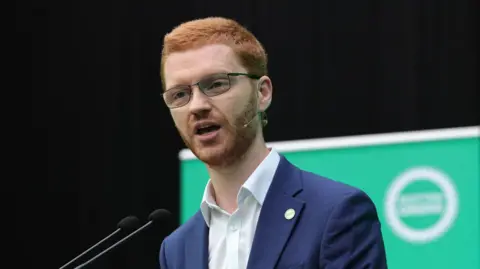
Scottish Green Party co-leader Ross Greer has said he is undecided on who to vote for in his own constituency in the upcoming Scottish elections.
With Greens candidates only standing in six of the 73 constituencies, he does not have the option of backing his party for the seat where he lives.
He ruled out Scottish Labour, blaming their actions in response to the Israel Gaza war, and went on to reaffirm that everyone can vote Green on the regional ballot paper.
Greer was questioned on BBC's Radio Scotland Breakfast following the party's manifesto launch.
"I've genuinely not decided yet with my constituency vote," he told the programme.
"To be honest, the more I look around the parties, I can't vote for a Labour Party that helped commit a genocide in Palestine for example."
After being grilled further he added: "What I do with my constituency ballot paper is probably going to be for the privacy of me in the polling station.
"I don't know if I'm going to announce it before then. It's not my job to say you should vote for any other party than the Greens."
In the upcoming elections, voters are given two ballot papers.
One is to vote for a constituency MSP, who will represent their local area, and another is for the regional ballot.
In the regional ballot, votes are cast for parties rather than individual candidates.
With 56 MSPs elected via the regional list ballot, Greer stressed: "Everyone in Scotland will have the opportunity to vote Green on their peach ballot, their regional ballot paper.
"Everyone in Scotland can vote Green.
"My job is to persuade people to vote Green – I know I'm going to vote Green with my regional ballot paper."
The co-leader was on Radio Scotland Breakfast to discuss the Scottish Green Party's manifesto that was launched on Tuesday.
It pledged to "transform" the country by expanding free childcare, free dental care, more support to small businesses and free bus travel which they would fund through tax changes.
The party also said it would tax the country's wealthiest individuals and companies, as well as polluting industries, to pay for public services.
The manifesto includes plans to replace council tax which Greer said was "comically broken", adding: "Most people pay the wrong rate".
He also told the programme he wanted to change how Scotland's economy worked.
This included supporting small and medium sized businesses that put money back into Scotland and are headquartered in the country.
He said: "We want to make sure we're maximising the wealth we generate here so that we can deliver Green policies like free bus travel for everyone."
The Institute for Fiscal Studies (IFS) said that while the Green manifesto recognises spending increases will need to be paired with tax hikes, it is unlikely that the tax rises outlined in the document would be sufficient to fund the plans.
"To pay for those, increases in taxes would probably have to be even larger than suggested, or cuts made to other day-to-day spending that the Scottish Greens deem lower priority," said David Phillips from the IFS.
He welcomed some tax proposals, including council tax reform, but said a rise in land and buildings transactions tax "would make a bad tax bigger and even more damaging".
Phillips raised further concerns that the party may have underestimated the costs of key proposals – including free bus travel for all, free dentistry, and free non-residential social care.
In return for the state-funded services, he said the manifesto would cement Scotland as the highest-taxed part of the UK.
He also raised questions about whether the ambitious plans could be delivered over a five-year parliamentary term "even if funding were available".

